WELCOME TO DEOM
Benefit from exclusive offers, updates & more by joining ournewsletter
 GOOFY PACKING
Handle Broken? Here’s How to Fix Weak Bag Handles (Kraft, Cardboard, or Custom)
2026-05-22 13:19:51
Click:
“
Handle Broken? Here’s How to Fix Weak Bag Handles (Kraft, Cardboard, or Custom)Y
”
Handle Broken? Here’s How to Fix Weak Bag Handles (Kraft, Cardboard, or Custom)
You’ve seen it happen.
A customer picks up a nicely printed shopping bag — and the handle rips right off. The bag drops. The product spills. And your brand looks… fragile.
If you sell kraft paper bags, white cardboard bags, or any custom paper bag with handles, the handle attachment point is the most stressed area. It’s where the bag fails most often.
But you don’t have to accept that.
In this guide, we’ll show you 3 practical ways to prevent handle breakage:
- Reinforce with extra paper
- Increase the paper weight (GSM)
- Change the handle type or attachment method
Let’s fix your bags — for good.
1️⃣ Why do handles tear off so easily?
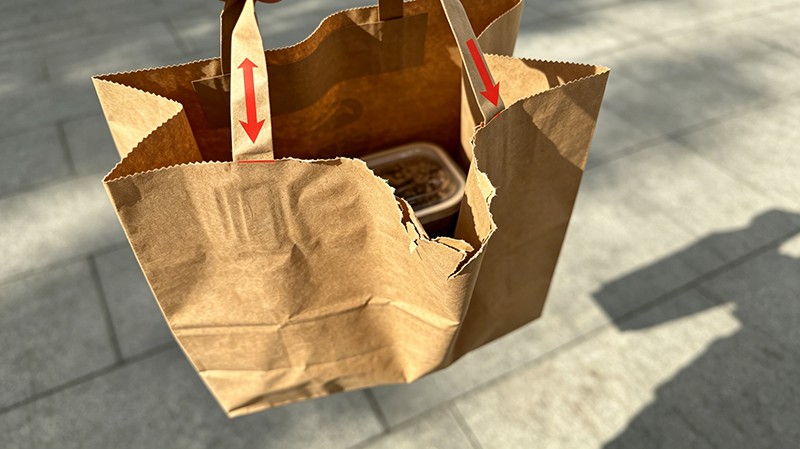
Most handle failures happen because of stress concentration.
- The handle pulls upward.
- The bag body resists downward.
- The tiny glued or punched area takes all the force.
Common weak spots:
- Die‑cut handle holes (no reinforcement)
- Twisted paper handles glued to a thin paper surface
- Rope or ribbon handles tied through a single punched hole
If your bag paper is too light (<150 GSM for medium loads), or the attachment area isn’t reinforced, it will tear.
2️⃣ Fix #1: Reinforce the handle attachment area
The simplest fix: add a reinforcement patch — an extra layer of paper or cardboard glued exactly where the handle connects.
Options:
| Reinforcement type | Best for | Cost impact |
|---|---|---|
| Paper patch (same material) | Light to medium loads | Low |
| Cardboard insert (0.5–1mm) | Heavy items (books, gifts) | Low–Medium |
| Metal eyelet / grommet | Rope or ribbon handles | Medium |
A small round or rectangular patch doubles the tear resistance at the hole. Many custom bag suppliers offer this as a standard upgrade.
3️⃣ Fix #2: Increase paper weight (GSM) — but not blindly
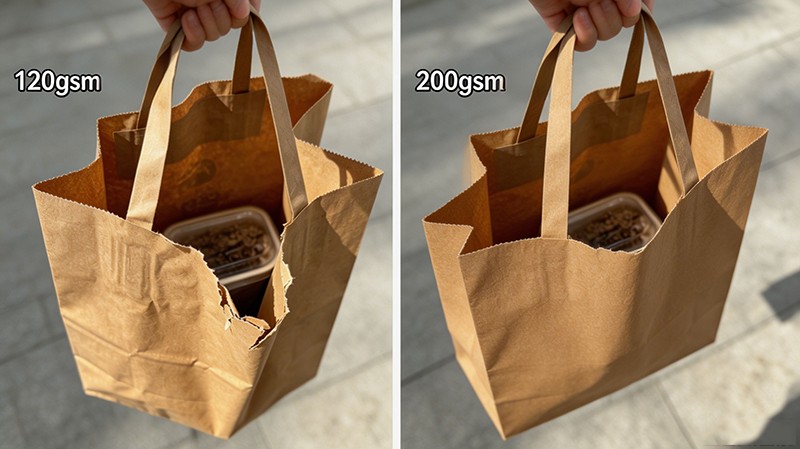
Higher GSM = stronger paper.
But heavier is not always better — it also increases cost and shipping weight.
Practical guide:
| Bag type | Recommended GSM | Max safe load |
|---|---|---|
| Light kraft bags (no handle or small) | 80–120 gsm | < 1 kg |
| Standard retail bags (twisted handle) | 120–150 gsm | 1–3 kg |
| Heavy‑duty kraft / cardboard bags | 150–200 gsm | 3–5 kg |
| Bottle bags / hardware store | 200+ gsm | > 5 kg |
If your current bags are 120 gsm and handles tear with 2 kg load, moving to 150–170 gsm often solves the problem without over‑engineering
4️⃣ Fix #3: Change the handle type or attachment method
Sometimes paper alone isn’t enough. Changing the handle itself can be a game changer.
Compare common handle types by durability:
| Handle type | Attachment method | Durability | Best use |
|---|---|---|---|
| Twisted paper handle (glued) | Glue + pressure | Medium | Light retail (clothes, gifts) |
| Flat paper handle (reinforced patch) | Glue + patch | High | Medium loads (books, cosmetics) |
| Die‑cut handle (hole in bag) | No extra part | Low | Very light items (bakery, small boxes) |
| Cotton / polyester rope | Grommet or reinforced hole | Very high | Heavy or luxury goods |
| Plastic snap‑in handle | Injection‑molded clip | Highest | Premium / industrial |
If your current bag uses simple glued twisted handles and still tears after reinforcement, switch to flat handles with patches or rope handles with metal eyelets.
5️⃣ Which fix is right for you? (Decision table)
| Your situation | Best solution |
|---|---|
| Bags already printed, don't want redesign | Add reinforcement patch (Fix #1) |
| Small increase in tear complaints | Increase GSM by 20–30 gsm (Fix #2) |
| Heavy products (wine, tools, multiple items) | Change to rope handle + grommet (Fix #3) |
| Budget is tight but need better quality | Glue reinforcement patch + same GSM |
| Premium brand, zero tolerance for failure | Flat handle + reinforced patch + 170+ GSM |
Still unsure? Order sample bags from your supplier with different fixes and test them with actual weight.
6️⃣ Don’t forget: the handle is part of your brand experience
A broken bag ruins the unboxing — or rather, the “carrying‑home” experience.
Customers remember the frustration, not your logo.
On the other hand, a bag that feels solid tells them:
- You care about details.
- Your products are worth the price.
- Your brand is reliable.
We’ve helped dozens of shops upgrade their bag handles — from small boutiques to online retailers. The cost per bag is often pennies, but the trust it builds is priceless.
???? Ready to fix your bag handles?
Get in touch with your current bag specs (size, GSM, handle type, typical load).
We’ll recommend the most cost‑effective reinforcement — and send you a test sample.









Prev : Food-Grade Paper Cups | Custom Printed & Eco-Friendly
Next : Paper Bag Printing Methods Explained: Flexo, Offset, Gravure, Digital, Screen & More
Your love is the driving force that keeps me writing.
YouArticle
已有0人推荐
Article recommendation
