WELCOME TO DEOM
Benefit from exclusive offers, updates & more by joining ournewsletter
 GOOFY PACKING
Paper Bag Printing Methods Explained: Flexo, Offset, Gravure, Digital, Screen & More
2026-05-22 14:47:44
Click:
“
Paper Bag Printing Methods Explained: Flexo, Offset, Gravure, Digital, Screen &
”
Paper Bag Printing Methods Explained: Flexo, Offset, Gravure, Digital, Screen & More
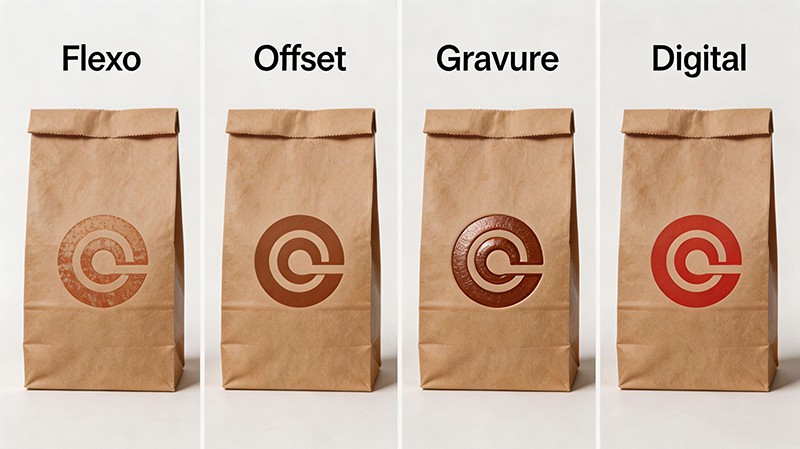
A paper bag is more than a carrier – it’s a moving billboard for your brand. But with so many printing methods available (flexo, offset, gravure, digital, screen, foil stamping, etc.), choosing the right one can be confusing.
This guide gives you a practical, decision‑oriented overview of each method. No fluff – just what you need to know to pick the best option for your order quantity, budget, and quality expectations.
We’ll cover:
- Flexography – the workhorse for large volumes, especially food‑safe bags
- Offset printing – the choice for high‑end, photo‑quality graphics
- Gravure – rich, heavy ink but expensive; rarely used today
- Digital printing – perfect for short runs and variable data
- Screen printing – thick, tactile ink for simple logos
- Decorative techniques – foil stamping, embossing, spot UV, lamination
- Hybrid printing – combining flexo + digital for personalisation at scale
Let’s dive in.
1. Flexography (Flexo) – The Workhorse for Large‑Volume Paper Bags
If paper bag printing had a “most valuable player”, it would be flexography.
How it works: A flexible relief plate (like a rubber stamp) picks up water‑based ink from an anilox roller and transfers it onto the paper web at high speed.
Three main advantages:
✅ Food‑safe & eco‑friendly
Flexo uses water‑based inks – no solvents, no odour, no migration risk. That’s why most bakery, takeaway, and food delivery bags are flexo‑printed.
✅ Works well on rough paper (kraft, natural paper)
Unlike offset, flexo plates conform to uneven paper surfaces. Your logo won’t look “broken” on textured kraft.
✅ Lowest unit cost at high volumes
Once the press is running, flexo produces tens of thousands of bags per hour. Unit cost drops significantly as quantity increases.
Limitations:
- Colour saturation and fine detail are slightly lower than offset.
- Requires plate making – not economical for very small runs (< 5,000–10,000 bags).
Best for: Takeout / delivery bags, grocery bags, bakery bags – volumes above 30,000 pieces, where cost and speed matter most.
2. Offset Printing – The “High‑End” Choice for Premium Bags

Offset is the gold standard for graphic precision.
How it works: Ink transfers from a plate to a rubber blanket, then onto the paper. The “middle step” creates a uniform, thin ink film with exceptional detail.
Three strengths:
✅ Superior colour fidelity
Sharp edges, smooth gradients, and accurate brand colours – offset delivers what designers dream of.
✅ Handles very fine text and lines
Fonts as small as 2‑3pt remain crisp.
✅ Preferred for luxury and high‑end brands
Think premium gift bags, cosmetic bags, high‑fashion retail.
Limitations:
- Higher plate cost and longer lead time (printing is done on flat sheets before bag‑making).
- Requires smooth paper – rough kraft can cause “mottling” or uneven ink coverage.
Best for: Luxury retail, cosmetic gift sets, high‑end boutiques – when visual perfection matters more than unit cost.
3. Gravure Printing – Rich Colour, but Largely Outdated for Paper Bags
Gravure uses a cylinder with tiny engraved cells that carry ink.
One real strength:
- Very thick ink laydown → deep, dense colours and excellent abrasion resistance.
But the downsides are significant:
- Very high cylinder engraving cost – makes sense only for millions of bags.
- Uses solvent‑based inks (less eco‑friendly) and is rarely compliant with modern food‑safe standards for paper bags.
Verdict: Almost never used for paper bags today. Not recommended unless you are an extremely large brand with a specific “heavy ink” requirement.
4. Digital Printing – Perfect for Short Runs & Variable Data
Digital printing has democratised small‑batch bag production.
How it works: Directly from a digital file to the printer – no plates, no minimum quantity.
Three superpowers:
✅ Zero setup cost – print 10 bags or 1,000 bags; no plate fees.
✅ Variable data – every bag can have a different QR code, serial number, or customer name.
✅ Extremely fast turnaround – perfect for sampling and last‑minute events.
Limitations:
- Unit cost is high when volumes exceed 5,000–10,000 bags.
- Colour consistency across different printers / batches can vary.
Best for: Samples, wedding favours, event bags, personalised marketing runs – quantities under 5,000 bags or when each bag needs unique content.
5. Screen Printing – Thick Ink, Tactile Feel, Simple Logos
[IMAGE: Figure 6 – Close‑up of a screen printing squeegee pushing ink through a mesh screen onto a paper bag]
Screen printing creates a thick, raised ink layer that you can feel.
How it works: A stencil (screen) is made for each colour; ink is pushed through the mesh onto the bag.
Pros & cons:
| Pros | Cons |
|---|---|
| Very thick, durable ink | Not suitable for photos or fine gradients |
| Works on any surface (rough kraft, textured paper) | Each colour needs a separate screen |
| Low setup cost for small batches (a few hundred bags) | Slow speed – not for mass production |
| Handmade, artisan feel | Lower detail than offset or digital |
Best for: Cafés, indie brands, limited editions – 1–2 colour logos on rough kraft paper, order quantities from 200 to 5,000 bags.
6. Decorative Techniques – Make Your Bag Feel Premium

Sometimes printing alone isn’t enough. These “add‑on” techniques elevate the perceived value:
Hot Foil Stamping (Gold / Silver / Rose Gold)
A metallic foil is pressed onto the bag using heat and pressure. Creates a shiny, luxurious logo. Perfect for gift bags, cosmetics, holiday editions.
Embossing / Debossing
Raised or recessed patterns without ink – purely tactile. Often combined with foil stamping for a high‑end, understated look.
Spot UV
A glossy, raised coating applied only to the logo or graphic. The contrast between matte paper and shiny UV makes the logo pop.
Lamination (Matte / Glossy)
A thin plastic film applied over the entire bag. Glossy = vibrant colours + durability. Matte = soft, velvety feel. Great for clothing and luxury bags.
???? If budget allows, offset + foil stamping + matte lamination is the “luxury trifecta”.
7. Hybrid Printing – Flexo + Digital (Best of Both Worlds)
What if you want the low unit cost of flexo and the personalisation of digital?
Hybrid printing does exactly that:
- Flexo units print the fixed design (brand colour, large solid areas) at high speed.
- A digital engine then adds variable elements – unique QR codes, customer names, limited‑edition patterns.
Perfect for:
- Seasonal campaigns (same base, different wishes)
- Membership / loyalty codes
- Small‑batch variations within a large order
Hybrid is still an emerging technology but will become more common as personalisation grows.
8. Which Printing Method Should You Choose? – Decision Table
| Your situation | Recommended method | Why |
|---|---|---|
| 30,000+ bags, food‑safe needed, budget‑sensitive | Flexography | Lowest unit cost, eco‑friendly, works on kraft |
| High‑end / luxury, perfect colour critical | Offset | Best colour reproduction, sharpest details |
| 500–5,000 bags, simple 1‑2 colour logo | Screen printing | Low setup, tactile ink, artisan feel |
| Test / sample run (a few hundred bags) | Digital | No plates, fast turnaround, variable data |
| Each bag needs a different QR code / name | Digital or Hybrid | Variable data impossible with flexo/offset alone |
| Want a “premium” look (gift, cosmetic) | Offset + Foil / Embossing | Decorative techniques double the perceived value |
| Maximum budget + maximum quality | Offset + Matte Lam + Foil + Emboss | The “Rolls‑Royce” of paper bag printing |
9. Practical Tips You Shouldn’t Ignore
Even with the right method, small mistakes can ruin a bag run. Keep these in mind:
① Light colours disappear on natural kraft.
White, light yellow, or pastel inks turn muddy on brown kraft. Use darker inks (deep blue, forest green, black) or request a white underprint (extra cost).
② Pure white on kraft is never “pure white”.
The brown base will shift white to cream/beige. If you need crisp white, consider coating or using white kraft paper.
③ Keep fine details away from fold lines and handle attachment areas.
Folding and punching can crack small text or thin lines. Position your logo in the upper‑middle of the bag body.
④ Always request a physical sample before mass production.
Screen colours, flexo registration, and offset colours on kraft can look different from your monitor. A sample bag saves costly surprises.
10. No “Best” Method – Only the Right One for You
- Flexo = large volume, food‑safe, cost‑efficient
- Offset = premium quality, fine detail, luxury
- Gravure = historically rich, now rarely used
- Digital = short runs, variable data, fast
- Screen = thick ink, simple logos, artisan feel
- Hybrid = fixed base + personalisation
Answer three questions:
- How many bags?
- What’s your budget for printing?
- What brand feeling do you want?
Still unsure? Send us your artwork and order quantity – we’ll recommend the most cost‑effective method and send you a sample proof.









Prev : Handle Broken? Here’s How to Fix Weak Bag Handles (Kraft, Cardboard, or Custom)
Next : How to Choose the Right Pizza Box Material & Thickness — A Complete Guide
Your love is the driving force that keeps me writing.
YouArticle
已有0人推荐
Article recommendation
