WELCOME TO DEOM
Benefit from exclusive offers, updates & more by joining ournewsletter
 GOOFY PACKING
How to Choose the Right Pizza Box Material & Thickness — A Complete Guide
2026-06-08 13:12:00
Click:
“
How to Choose the Right Pizza Box Material & Thickness — A Complete GuideIntrodu
”
How to Choose the Right Pizza Box Material & Thickness — A Complete Guide
Introduction
A pizza box does more than just hold a pizza. It protects the crust, keeps toppings from sticking to the lid, retains heat, and presents your brand — all while surviving delivery bumps and steam buildup. But with so many material and thickness options available, how do you choose the right one for your pizzeria or frozen pizza brand?
In this guide, we’ll walk you through:
- The most common pizza box materials (and their pros & cons)
- How to determine the correct thickness (ECT & board weight)
- Special coatings for grease and moisture resistance
- Customization options that elevate your brand
By the end, you’ll know exactly which pizza box fits your product, budget, and sustainability goals.
Part 1: Pizza Box Materials — Which One Is Right for You?
Most pizza boxes are made from corrugated cardboard or paperboard. Each has distinct characteristics.
1. Corrugated Cardboard (Most Common)
Corrugated pizza boxes consist of three layers: an outer liner, an inner liner, and a fluted medium in between. The flutes provide strength and insulation.
| Flute Type | Thickness | Best for |
|---|---|---|
| E-flute | 1.5–2 mm | Thin-crust, personal pizzas, frozen pizzas (good print surface) |
| B-flute | 2.5–3 mm | Standard hot delivery pizzas (most popular) |
| C-flute | 3.5–4 mm | Extra-large or heavy pizzas, double-decker pizzas |
| A-flute | 4.5–5 mm | Very heavy pizzas, catering boxes (rare for pizza) |
Pros of corrugated: Excellent strength-to-weight ratio, good insulation, cheap, recyclable.
Cons: Not as premium-looking as solid board; printing details may be slightly less sharp on fluted surface.
2. Solid Bleached Board (SBB) / Paperboard
What it is: A thick, smooth, single-ply paperboard (not fluted). Typically used for high-end, frozen, or retail pizza boxes.
Pros: Superior print quality (photorealistic graphics), elegant white surface, smooth finish, often with a grease-resistant coating pre-applied.
Cons: Less insulation than corrugated, less stacking strength, heavier per square meter, higher cost.
Best for: Premium frozen pizzas (supermarket shelf), take-and-bake pizzas, or gift-style pizza presentations.
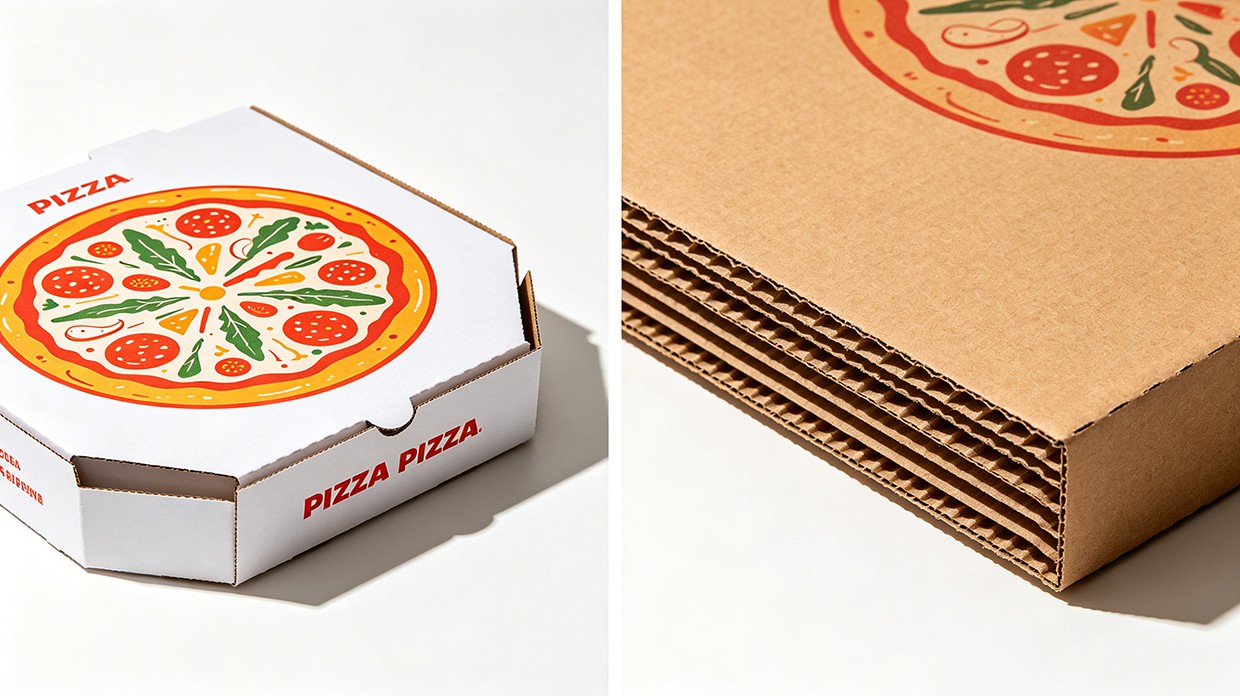
3. Kraft Paperboard (Natural / Brown)
What it is: Unbleached brown paperboard (can be solid or corrugated). Often associated with artisan, organic, or eco-friendly brands.
Pros: Natural, rustic look; made from recycled content; no bleaching chemicals; highly recyclable.
Cons: Darker surface limits printing contrast (use white ink or foil stamping); may appear less “clean” than white board.
Best for: Organic pizza brands, wood-fired pizzerias, eco-conscious takeout.

Part 2: Understanding Thickness — ECT, Board Weight & Flute Size
Thickness directly affects strength, insulation, and cost. Two key metrics to know:
2.1 Edge Crush Test (ECT)
ECT measures how much stacking force a box can withstand before collapsing — critical for stacking multiple pizzas during delivery or in a delivery bag.
| ECT Rating | Stacking Strength | Best for |
|---|---|---|
| 23 ECT | Low (light duty) | Single pizza, short delivery distance |
| 32 ECT | Medium | 2–3 pizzas stacked, standard delivery |
| 44 ECT | High | 4+ pizzas, catering, long delivery times |
Note: Higher ECT usually means thicker board or stronger flutes.
2.2 Board Weight (gsm / lbs)
For solid paperboard (non-corrugated), thickness is measured in grams per square meter (gsm) or points (pt).
| Thickness | gsm range | Best for |
|---|---|---|
| Light | 350–400 gsm | Small / personal pizzas (6–8 inches) |
| Medium | 450–550 gsm | Standard 10–12 inch pizzas |
| Heavy | 600–700 gsm | Large 14+ inch or thick-crust pizzas, frozen pizzas |
For corrugated, the flute type (E/B/C) already determines thickness, but you can also specify liner weight (e.g., 125gsm liners + B-flute).
Part 3: Special Coatings — Why Grease & Moisture Resistance Matter
Pizza is hot, oily, and steamy. Without protection, the box can:
- Absorb oil → weakens the box → bottom collapses
- Get soggy from steam → crust loses crispness
- Leak oil onto clothes or delivery bags
We offer two key coatings:
1. Grease-resistant coating (GRC) — Applied to the inner surface. Creates a barrier against oil from pepperoni, cheese, and sauces. Available in fluorochemical-free (FDA-compliant) formulations.
2. Moisture-resistant / vapour barrier — Prevents steam from softening the board. Essential for hot, freshly baked pizzas.
Recommendation: For any hot pizza delivery, always choose grease-resistant coating. For extra-large or double-topping pizzas, add moisture barrier.

Part 4: Ventilation — A Critical but Often Overlooked Feature
Pizza releases steam immediately after baking. If the box is completely sealed, steam condenses into water, making the crust soggy. The solution:
- Ventilation holes — Small perforations on the lid or side walls allow steam to escape while retaining heat.
- Clinch-style flaps — Small tabs that keep the lid slightly open during the first few minutes, then can be closed for delivery.
We can add custom vent patterns (size, number, location) based on your pizza size and crust style.
Part 5: Customization Options Beyond Material & Thickness
Once you’ve selected the right material and thickness, you can further customize:
- Custom size — Any diameter from 6” to 18”+, square or rectangle for sheet pizzas.
- Custom printing — Full-color logo, brand story, cooking instructions, or even a “Recycle Me” message.
- Window cutout — Cellophane window on the lid to show the pizza (popular for frozen pizzas).
- Corner cuts / locking tabs — Improved assembly speed and lid security.
- Eco-friendly options — Recycled content, water-based inks, no-wax coatings, and compostable materials.
Part 6: Quick Selection Guide — Which Pizza Box Should You Choose?
Use this simple flowchart (text version):
- Q: Is your pizza delivered hot or sold frozen?
- Q: How many pizzas are usually stacked?
- Q: Does your pizza have oily toppings (pepperoni, extra cheese)?
- Q: Do you need eco / organic branding?
Why Source Your Pizza Boxes From Our Factory?
✅ Material expertise — We help you select the right flute, board weight, and coating based on your pizza type.
✅ Full customization — Any size, any print, any window, any vent pattern.
✅ Food-safe & certified — FDA / LFGB compliant materials, grease-resistant coatings, and water-based inks.
✅ Low MOQ & fast turnaround — Sample boxes in 5–7 days, mass production in 15–20 days.
✅ Eco-friendly options — FSC-certified, recycled content, compostable boxes available.
Ready to Order the Perfect Pizza Box?
Still not sure which material and thickness to choose? Contact our team — send us your pizza size, typical toppings, delivery distance, and stack quantity. We’ll recommend the optimal box and send a free sample for testing.
Get a free consultation & quote today.









Your love is the driving force that keeps me writing.
YouArticle
已有0人推荐
Article recommendation
